
Where Pike County Crime News Appears
The Sheriff's own publications anchor the county's crime news. Its Weekly Arrests query lists everyone held over the past seven days, dated and structured. The Press Release archive works differently. There the agency picks which investigations and post-booking events to announce, case by case. Neither channel offers a routine stream of booking photos, though both point readers toward the Sheriff's official social accounts.
Local papers fill in the picture. Quincy Herald-Whig runs weekly booking-report stories under Crime & Justice. Muddy River News keeps a Pike County category and a Sheriff blotter, and it sometimes republishes the official weekly PDF. Regional outlets join in too. A My Journal-Courier Police Beat feature from November 2023 ran "this week's wanted" entries with photos and descriptions. Pike Press and other print titles remain solid leads for older archive material.
No Pike County TV or radio station carries a regular local booking-photo feed. Don't plug that gap with a generic crime page or an out-of-state Pike County result. A news story can give you a date, an agency, and a charge. For custody status or a court outcome, you still need the originating record.
Pike County Outlet Inventory
Coverage makes the most sense when each outlet's role is stated plainly. Put the official sources first. A newspaper can summarize the Sheriff's report, but it may skip a field or miss a later court development. Third-party indexes can preserve old material. Treat none of them as a current Pike County custody system.
| Outlet | Coverage | Photos? | Where to look |
|---|---|---|---|
| Pike County Sheriff Weekly Arrests | Official weekly incarceration query with the displayed date range, agency, charges or holds, and confined or released fields. | No routine images in the observed table. | Sheriff Weekly Arrests |
| Pike County Sheriff Press Releases | Selected case statements, including lodging, release pending court, or transfer language. | Some case-specific image attachments, not a complete list. | Press Release archive |
| Quincy Herald-Whig | Countywide weekly booking stories and Crime & Justice reporting, sourced from Sheriff records. | Sampled weekly stories used a generic agency image, not a routine individual gallery. | Crime & Justice; a July 2026 booking report |
| Muddy River News | Pike County community coverage, weekly blotter posts, and occasional mirrors of official reports. | Sampled pages were text-forward or used generic publication or agency images. | Pike County category; Blotter |
| Pike Press and print archives | Historical print and archive leads. The current Pike Press domain redirects to a regional site, and no current public photo section was verified. | No current online photo feed verified. | NewsLibrary Pike Press archive |
| My Journal-Courier | Historical regional Police Beat example with a “this week’s wanted” feature from November 2023. | That historical feature used photographs and descriptions; it is not a current Sheriff roster. | November 2023 example |
| Mugshots.com | Historic third-party Pike County, Illinois archive with city labels including Pittsfield, Barry, and Griggsville. | Individual pages may carry images, but the archive is not a live official feed. | Pike County, Illinois section |
| WhosArrested | Unofficial copied older weekly material and county-level search pages. | No current official photo guarantee; local opt-out link was not usable in research. | Pike County Illinois page |
| JailExchange | Third-party jail directory and booking-navigation pages for the county facility. | Not a verified live roster; no clear local free correction path was found. | Recent bookings page |
| InmateAid | Secondary facility directory and contact context, not a county arrest log. | No verified local booking-photo feed. | Pike County Jail directory |
| RecentlyBooked | The Illinois index did not contain a verified Pike County, Illinois local page. | No local page inspected; a generic policy does not establish local coverage. | Illinois index |
| Busted Newspaper, Arrests.org, and Mugshots.zone | No verified Illinois Pike local section was established. Probes led to no local page, access limits, or a Pike County in another state. | Do not use wrong-state images or pages as Illinois records. | No verified Illinois Pike link |
Take the third-party entries as leads and nothing more. Mugshots.com is the only verified commercial archive in this set with a clear Illinois Pike URL, and its date filters pointed to older material. WhosArrested, JailExchange, and InmateAid mention the county without offering a confirmed current booking stream. RecentlyBooked's statewide index and its policies prove nothing about whether a Pike County, Illinois page even exists.
How Booking Photos Reach the News
In Pike County, a photograph can come from a selected Sheriff Press Release, a records request to the agency that maintains the booking file, or a later state-custody record that is not the county intake image. The Weekly Arrests table inspected in the research had no routine photo column. The Sheriff’s Press Release archive sometimes attaches case-specific booking-photo-style images, but it is selective and cannot be used to infer that every booking has a public photograph.
Illinois FOIA Section 2.15 lists a photograph when and if available among arrest information that criminal-justice agencies must furnish as soon as practical and no later than 72 hours after arrest. That language supports a focused request. It does not require an agency to post a photo online, create an image that was never taken, or release material covered by another exemption. A request should identify the person, arrest date or range, arresting agency, and whether the image is a booking photograph.
Illinois correction law also matters when published criminal-record information is inaccurate. It addresses correction and bars covered pay-to-remove demands, while preserving statutory exceptions. It does not make every accurate photo disappear on request. The practical sequence is to correct the originating record, provide lawful documentation to a publisher, and avoid paying a business that promises to suppress an accurate record.
News organizations make their own publication choices. Herald-Whig and Muddy River samples were text-forward or used generic agency images rather than routine face tiles. That choice reduces the chance that a selective booking image will be mistaken for a complete county record. Faces should not be rehosted, and no photo grid should be built from a newspaper or third-party page.
The Sheriff Press Release archive is the correct source for a case-specific image when the agency has chosen to publish one. The archive’s existence does not change the official Weekly Arrests photo behavior.
The Herald-Whig weekly Pike booking report is a useful example of a local story that points back to the Sheriff’s records without displaying a routine face gallery.
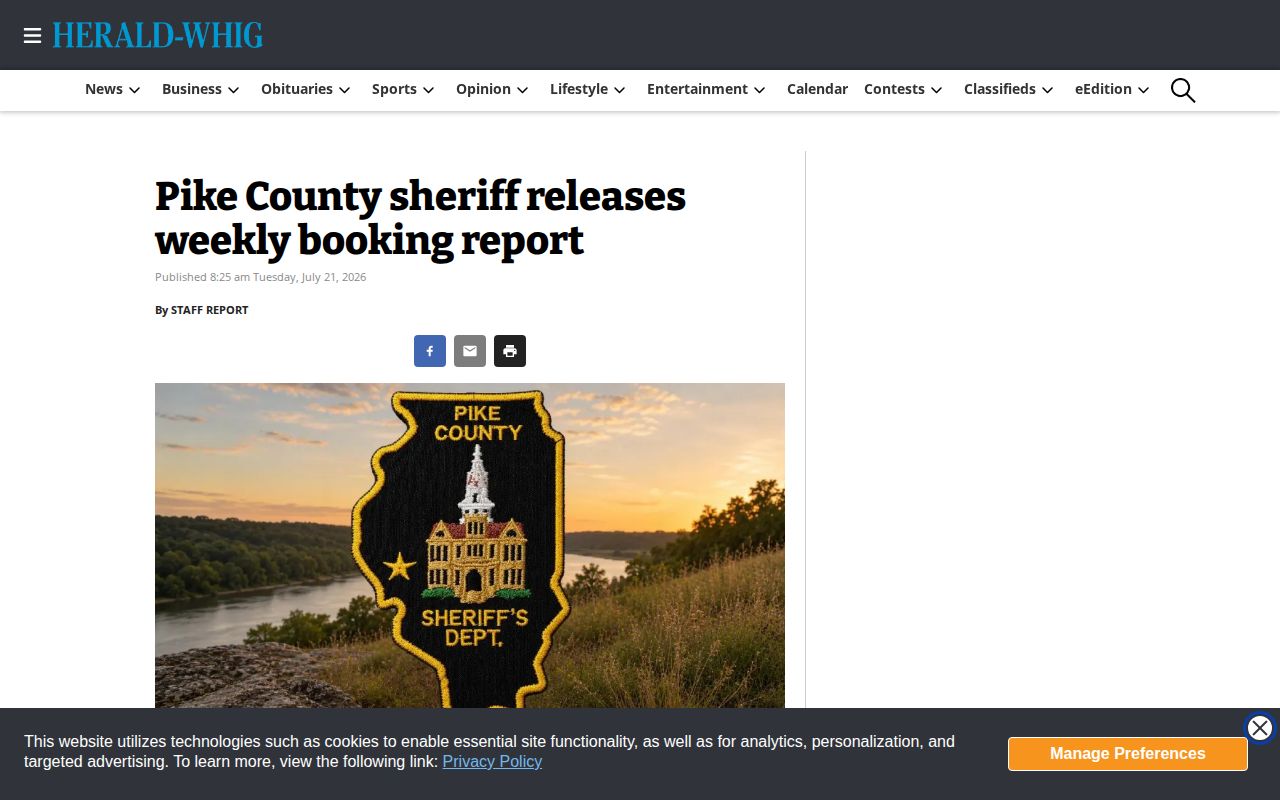
The Herald-Whig capture shows a weekly booking story using a generic Pike County Sheriff image, not a rehosted booking portrait. Its date and headline help locate the official report, while the Sheriff remains the primary record source.
From a Pike County Story to Records
A news story is a starting point, not a destination. Check the source date, the agency, and the wording. That tells you which official record comes next. A name in a weekly article usually means someone booked during that report window. A later release or transfer may never appear in the same story.
- Record the article date, the stated arrest or booking period, the arresting agency, and the exact charge language. Keep “charged,” “held,” and “released” separate because each describes a different event.
- Open the official Weekly Arrests report and read its displayed seven-day range. Look for the arresting-agency field and the confined or released field. This is a dated county jail log, not a live current-custody page.
- If the story is newer than the weekly range, use the countywide booking and records search for the Sheriff Records / FOIA fallback. For a Pittsfield arrest report, the city police record route may also be needed because the arresting agency holds the incident report.
- Use the official Pike County Judici case search for what happened after booking. A CAPTCHA, sealed case, or missing docket entry should lead to the Circuit Clerk rather than to an aggregator.
- Read the disposition, not just the booking charge. A case can be amended, reduced, dismissed, resolved by plea, or otherwise changed. A release from Pike County Jail also does not state why the person was released or whether another authority took custody.
Know which agency holds the answer. For state prison or parole questions, IDOC is the right office. Federal custody falls to BOP. ICE handles immigration holds. None of these will produce a Pike County booking record. That lives with the county jail and the court docket, so a state or federal lookup never substitutes for it.
Pike County News Runs Countywide
Arrest coverage here works countywide. It also tends to run weekly rather than daily. Herald-Whig and Muddy River News name the place when it shows up in the Sheriff's report. That could be Pittsfield, Barry, Griggsville, Pleasant Hill, or a rural stretch of the county. One report can mix Pike County Sheriff entries with Pittsfield Police Department entries. So the arresting-agency line deserves a close look.
City policing arrangements also shape where a story points. Pittsfield runs its own Police Department, but its public police page offers no standalone arrest blotter. Barry contracts law enforcement through the Pike County Sheriff's Department, per its official city page. The Sheriff's Patrol Division counts Griggsville among the towns it covers. A city headline, in other words, often lands you in the county jail report instead of a city booking feed.
City-level record paths still help. The countywide weekly report and records route covers Pittsfield Busted Mugshots, Barry Busted Mugshots, and Griggsville Busted Mugshots. The incident report itself stays with whichever agency made the arrest. And a city name in a story does not mean that city runs its own jail or photo archive.
After a Pike County Booking
The official Press Release archive shows what can follow a booking. Someone might be lodged at the Pike County Jail, released pending court, moved to state or federal custody, or routed through a juvenile process. Each statement covers one case only. They should not be read as a pattern for every Weekly Arrests entry.
Remember that the weekly report is a snapshot tied to a date range. Its "Released" field marks a custody transition within that report, and release from Pike County custody can mean a transfer to another authority. To follow the legal case itself, the later court docket is what matters.
Judici is the next official stop for a public case record. If an online result comes up incomplete, sealed, or blocked, the Circuit Clerk is the fallback. Sealing and expungement can also apply. A later court order always outranks an old story or a third-party copy.
Keeping these layers side by side is the point. The news layer shows what an outlet chose to publish. The jail layer shows what the dated report recorded. The court layer shows what happened in the case, and none of the three stands in for the others.
Pike County News and Innocence
Use neutral language when comparing a story with a record. Say that a person was booked, charged, listed, confined, released, or transferred only when the source supports that word. Do not call a person a criminal because a news article or image appears in a search result.
Official sources lead because they show the custodian and the date. Local outlets remain valuable for discovery and context. Third-party pages are less reliable, may be stale, and can preserve a copied accusation after the official record changes. When the sources disagree, contact the originating agency or court and keep the source dates visible.