
Pike County Most Wanted
The Pike County Sheriff's site does not currently offer a Most Wanted page in its navigation or search results. There is no official count of listed people, no update schedule, no dedicated wanted-photo section, and no "Warrant Wednesday" feature to verify. That absence matters. A blank search result should stay blank rather than being filled with names pulled from a commercial index, an old news story, or a page for a Pike County in some other state.
What the Sheriff does publish centers on the Pike County Jail. Records, Weekly Arrests, Press Releases, and news updates make up the main channels. The Weekly Arrests report can include people already booked on a warrant, body attachment, or failure to appear language. That makes it a post-booking custody record, not a pre-arrest most-wanted roster. Press releases are selective and may carry a case photo, but they do not amount to a full list of people the Sheriff is seeking.
If the Sheriff publishes a wanted listing later, read it as an agency request for information. The originating agency controls any image, so no face belongs on a countywide gallery or a copied results page.
No Current Pike County List
Pike County has no official Most Wanted page right now. The Sheriff's office also lacks an online warrant portal. What the county does offer is a Patrol Division that points people to Crime Stoppers for anonymous tips, plus general contact lines for records. Neither one amounts to a public roster. Neither one confirms that any named person has an active warrant.
Local news fills the gap only in pieces. A November 2023 My Journal-Courier Police Beat feature ran a "this week's wanted" item with photos and descriptions. That was a newspaper piece, not a government list. It shows a newsroom has published wanted material before, but it proves nothing about a schedule, a current count, or any photo policy today.
Old notices linger online. A warrant gets resolved, a person is booked, a case changes in court, and the stale item still turns up in search. So check the date, the publisher, and the official source behind any wanted claim. Missing details? Treat the item as a lead to verify, nothing more.
What a Pike County Listing Shows
With no current Sheriff roster to draw from, the table below keeps supported facts apart from guesses. The local-news example relied on photographs and descriptions. The official weekly report works differently, using names, arresting agencies, charge or hold rows, and confined or released fields. These are separate record types. Blending them into an invented wanted profile would misrepresent both.
| Field | What the Pike County sources support |
|---|---|
| Listed name | A historical wanted feature used a person’s name. No current official Sheriff list was located for a present name list. |
| Photo or description | The November 2023 news example used photographs and descriptions. The Sheriff’s current public source map does not verify a current wanted-photo page. |
| Warrant or case basis | A notice may state its basis, but a Weekly Arrests hold row is not a full warrant record. Read the exact wording and verify it with the court or agency. |
| Publication date | The date is essential for judging whether a notice is current. No official posting cadence was found. |
| Tip route | Crime Stoppers of Pike County is the verified anonymous tip route. A tip line does not confirm legal status or guarantee a public listing. |
A third-party search result cannot give you a last-known address, a physical description, a caution flag, or a photograph. Those fields in the official report are sensitive details. They are not filler to repeat. A copied image proves nothing about identity. Ask the record custodian for the document that answers your actual question.
How to Read Pike County Notices
Start with an official source and put safety first. Since no current Most Wanted page exists, step one is confirming whether any new notice has been published at all. A name on a list is never a reason to confront someone, follow a car, knock on a door, or send others to do it for you. Leave contact to the Sheriff.
- Start with the Pike County Sheriff’s official website and its current News, Press Release, and Patrol links. Do not accept a search result that sends you to a different Pike County or an unattributed page.
- Read the notice date, issuing agency, alleged basis, and tip instructions. If any of those are missing, record the item as unverified rather than treating it as an active notice.
- Do not approach or attempt to identify the person in public. Send useful information through the official tip route, and call 911 when there is an immediate emergency.
- For a booked person, compare the official Weekly Arrests date range and arresting-agency field. A row may say confined or released, but it is a dated snapshot, not a live locator.
- For the countywide booking and records path, use the Pike County arrest and booking record search. Follow its official-source route instead of copying a face or relying on an unofficial roster.
Wondering what happened after an arrest? That answer sits with the court. A booking charge can be amended, reduced, dismissed, or resolved some other way. The wanted notice and the jail report stop short of that outcome.
Pike County Tips and Crime Stoppers
Crime Stoppers of Pike County takes anonymous tips at 217-285-1500. Callers stay nameless, and some tips earn cash rewards. Rewards are possible, never guaranteed. The Patrol Division handles the program, so the tip line is the right place to send what you know about a wanted person or a crime. Emergencies should go straight to 911 instead.
Pass along facts, not guesses. Say plainly what you saw yourself and leave rumors out. The Illinois Crime Stoppers directory lists the Pike County program alongside others statewide.
Crime Stoppers of Pike County
217-285-1500
The Sheriff's Patrol Division describes anonymous tips and possible cash rewards. For a statewide listing of programs, Illinois Crime Stoppers is the resource to use.
The official contact route is different from the tip route. Records staff can address a public record request, while Crime Stoppers receives information about suspected crimes or wanted people. Neither channel gives a private citizen authority to detain or confront someone.
The Sheriff’s Patrol page also places the tip line in a broader countywide law-enforcement setting. That is useful context, but it is not a promise that every tip becomes a press release, a wanted entry, or a public case update.
The official Patrol Division page is the best source for the verified tip contact and local coverage language. It contains no current wanted gallery. The absence of a gallery is a safety feature, not a gap to fill with copied faces.
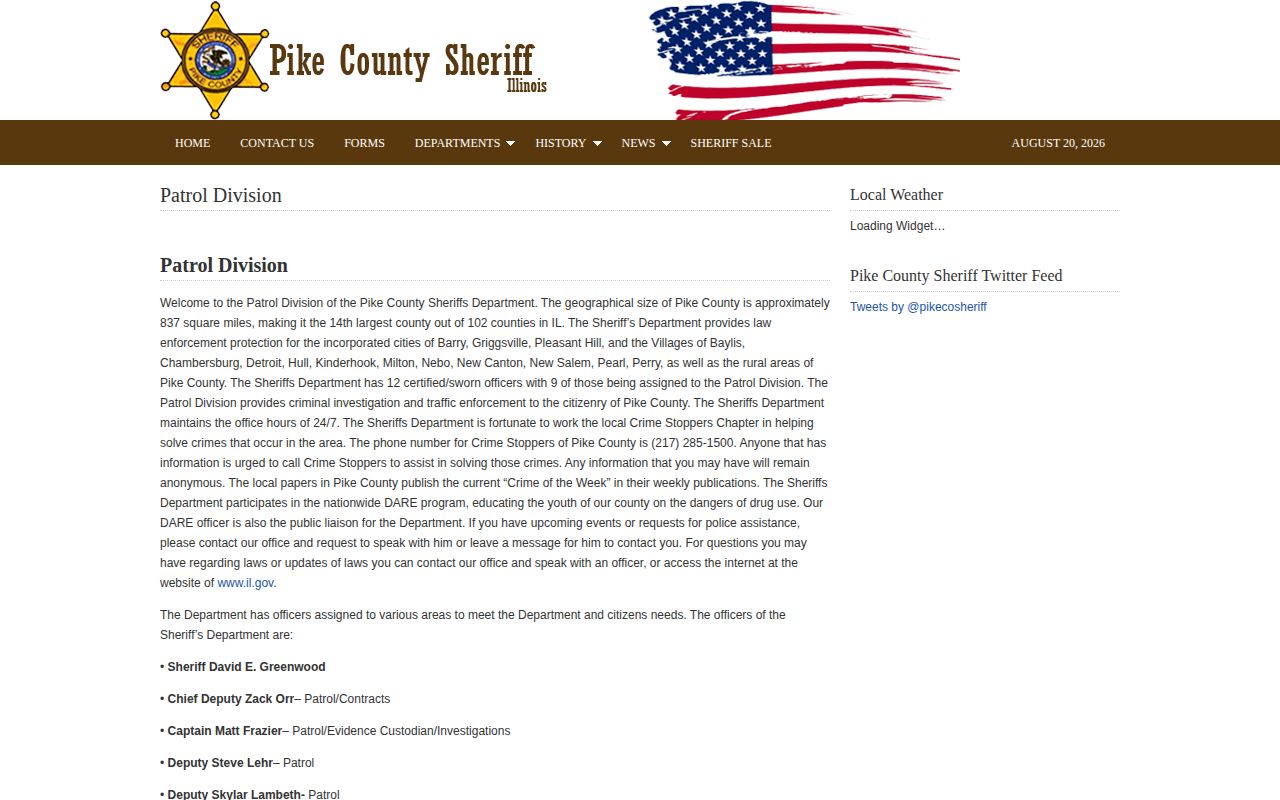
The screenshot shows the Sheriff’s Patrol Division source and its Crime Stoppers context, not a list of wanted people. It is presented as a source reference, not as a replacement for the agency’s current instructions.
Pike County Warrant Check
The Sheriff's public website has no searchable warrant portal. That does not mean no warrants exist. It simply means there is no instant countywide warrant validation form online. A Weekly Arrests entry can carry post-booking language like "Wanted on Warrant," "Body Attachment," or "Failure to Appear," but that line describes someone already booked, not a warrant check on a free person.
The court route starts at the Pike County Circuit Court page, which links to Judici case search. Judici may omit sealed or nonpublic matters. A docket result can help locate a case, though the Circuit Clerk remains the official fallback. The Illinois courts directory lists the Circuit Clerk at 217-285-6612 and the courthouse at 100 E. Washington Street, Pittsfield, Illinois 62363.
For a Sheriff booking or hold record, use the Sheriff's contact route and the Records / Civil Process page. That office answers at 217-285-7000, extension 101, or abrawdy@pikecountysd.org. It is not an instant warrant portal, but a records request can clarify what a public agency report says, subject to access limits.
Keep three ideas separate. A warrant check is verification. A wanted notice is a public safety request. A post-booking hold is a custody label. Sorting them keeps a dated jail entry from being mistaken for proof that an unbooked person is wanted today.
Check a Pike County Warrant
Start with the court docket if the concern is one person's status before a judge or agency. It moves slower than the jail side. A weekly custody report may show a booking first. The docket can lag behind, or the reverse can happen. Do not use this route to dodge service or stall a lawful process. Anyone named on a warrant or hold should call an attorney or the court clerk for advice on their own case.
- Write down the exact name and any case detail you already know. Do not publish a name or identifying detail while asking strangers to investigate it.
- Search the official Pike County Judici case path. Compare the county, parties, case type, and docket details because similar names can produce the wrong record.
- If Judici does not answer the question, call the Pike County Circuit Clerk at 217-285-6612 or use the courthouse information in the official court directory. Ask about public case information, not a prediction about the outcome.
- For a Sheriff record, contact Records / Civil Process at 217-285-7000, extension 101. Request clarification or submit a focused FOIA request for the booking or hold record, rather than asking a third-party index to certify a warrant.
- If there is an immediate safety concern, call 911. If there is information about a suspected wanted person and no immediate emergency, use Crime Stoppers at 217-285-1500. Do not approach the person.
Timing matters here. A docket entry and a jail report are often created on different days. That is why they rarely match up perfectly. The court might log a procedural event first, and the weekly roster will reflect the custody change a few days later.
Pike County Warrant Types
Charge and hold rows are what the Weekly Arrests report works with, so a full public warrant file is out of scope here. The labels that follow simply explain language you might see on a booking entry. Treat them as a reading aid, nothing more. They say nothing about the legal standing of anyone who never appears on the list.
| Record language | Careful reading | Verification route |
|---|---|---|
| Wanted on warrant | A post-booking hold or charge row says a warrant was involved. It is not a live public warrant search result. | Pike Circuit Clerk / Judici for the public court record, or Sheriff Records for an agency-held record. |
| Body attachment | A court-related hold label may appear in the booking data. The weekly row does not explain the order or current status. | Ask the Circuit Clerk or an attorney about the public case record. |
| Failure to appear | FTA is a procedural label. It does not prove the underlying charge and does not by itself supply a complete warrant file. | Review the docket and confirm with the Clerk when online information is incomplete. |
| State or federal hold | A hold or transfer can mean another authority is involved. Release from Pike County custody does not always mean release from all custody. | Ask the responsible state or federal authority, not a third-party mugshot index. |
Read "hold" as a custody word unless officials say otherwise. Someone can sit in jail, walk free, or move to another facility while the court case stays open behind it. So check the dated report itself. Keep its reporting window in mind as you go.
Pike County Wanted Safety
A wanted poster deserves a careful read. Notices can sit online long after they expire, two people can share one name, and a photo travels fast once it leaves the agency's page and its context. So don't repost a face as if identity were confirmed. Pass along what you know to trained officers instead, and let the court and the agency sort out the facts.
The source chain here is narrow on purpose. Sheriff records hold what the agency knows, the Circuit Clerk and Judici carry public court files, and Crime Stoppers takes tips. Third-party pages can be stale or plain wrong. Verification always belongs to the office that created the record.